Mounjaro Dosage: A Guide to Tirzepatide Doses
What is Mounjaro?
Mounjaro contains tirzepatide, a medicine used to manage type 2 diabetes and, in appropriate adults, for weight management. It belongs to a class of medicines known as GLP-1/GIP receptor agonists. Tirzepatide works on hormone receptors involved in appetite and blood glucose regulation.
Mounjaro is administered as a once-weekly injection. The dose is generally increased gradually rather than starting immediately at a higher dose. This gradual approach is part of the licensed dosing schedule and can help manage gastrointestinal side effects associated with treatment.
What is the starting dose of Mounjaro?
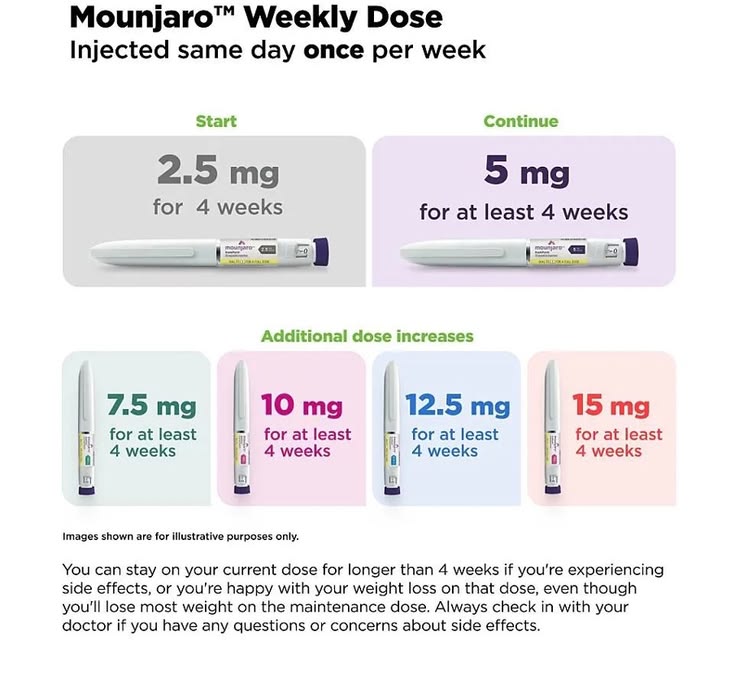
For adults, the licensed starting dose of tirzepatide is:
2.5 mg once a week
This starting dose is used for the first four weeks.
After four weeks, the standard next step is:
5 mg once a week
Further dose increases may be considered by the prescribing healthcare professional depending on the individual’s treatment response and tolerability.
Do not increase your Mounjaro dose yourself. Your prescriber should determine whether a dose increase is appropriate.
Mounjaro dosage schedule
For adults, the licensed dosing schedule can be summarised as follows:
| Treatment stage | Dose |
|---|---|
| Starting dose | 2.5 mg once weekly |
| After at least 4 weeks | 5 mg once weekly |
| Further increases | 7.5 mg → 10 mg → 12.5 mg → 15 mg |
| Maximum adult dose | 15 mg once weekly |
Further increases are made in 2.5 mg increments, and patients should remain on their current dose for at least four weeks before moving to a higher dose if an increase is clinically appropriate.
Important
This table explains the licensed dosing framework; it does not mean that everyone should progress through every dose.
Some people may remain on a lower dose depending on their individual circumstances, treatment response and tolerability. A clinical team should determine the appropriate dose.
Why does Mounjaro start at 2.5mg?
Mounjaro is started at a relatively low dose before being increased gradually.
One reason is tolerability.
Gastrointestinal side effects such as nausea, vomiting and diarrhoea are particularly associated with periods of dose escalation. UK product information reports that these effects generally decrease over time.
Starting at 2.5 mg therefore forms part of the licensed escalation process rather than being the intended maximum treatment dose.
When is the Mounjaro dose increased?
For adults, the dose may be increased in 2.5 mg increments after a minimum of four weeks on the current dose, when further treatment is appropriate.
The decision to increase should take account of factors such as:
- your response to treatment
- side effects
- your medical history
- other medicines you take
- your treatment goals
- your healthcare professional’s assessment
A higher dose isn’t automatically better for every patient.
What are the different Mounjaro doses?
Mounjaro KwikPen is available in several strengths for adults:
- 2.5 mg
- 5 mg
- 7.5 mg
- 10 mg
- 12.5 mg
- 15 mg
Each KwikPen contains four doses of the specified strength.
The 15 mg dose is the maximum adult dose listed in the current UK product information.
How often is Mounjaro taken?
Mounjaro is taken once a week.

You can generally administer it at any time of day, with or without food, according to the instructions provided with your medicine. It is recommended to use it on the same day each week.
If you need to change your injection day, there should be at least three days between doses.
What happens if you miss a Mounjaro dose?
If you miss a dose, the current UK product information states that you can administer it as soon as possible within four days.
If more than four days have passed, skip the missed dose and take your next dose on the regular scheduled day.
You should not take two doses at the same time to make up for a missed injection.
If you’re unsure what to do after missing a dose, speak to your pharmacist or prescriber.
Can you increase Mounjaro dosage faster?
No.
The licensed adult dosing schedule requires at least four weeks on the current dose before a further 2.5 mg increase, when an increase is appropriate.
Increasing the dose more quickly than recommended could increase the risk of adverse effects.
Never increase your dose because you feel that your current dose isn’t working quickly enough.
Does a higher Mounjaro dose mean more weight loss?
Treatment response varies between individuals.
The appropriate dose isn’t determined simply by choosing the highest available strength. Your healthcare professional should consider your response, tolerability and individual circumstances.
For weight management, the UK product information states that if a patient has not lost at least 5% of their initial body weight six months after titrating to the highest tolerated dose, the decision to continue treatment should be reassessed based on the individual’s benefit-risk profile.
This is one reason why treatment should be monitored rather than treating the maximum dose as the goal for everyone.
Mounjaro dosage and side effects
Some side effects are particularly common during dose escalation.
The most frequently reported gastrointestinal effects include:
- nausea
- diarrhoea
- vomiting
- constipation
- abdominal pain
These effects are reported more frequently during dose escalation and generally decrease over time.
If side effects are severe, persistent or affecting your ability to eat, drink or carry out normal activities, speak to your healthcare professional.
What happens if you take too much Mounjaro?
Taking more tirzepatide than prescribed can be dangerous.
The NHS advises seeking urgent medical advice through NHS 111 if you have used more than your prescribed dose.
Do not attempt to compensate for a missed dose by taking extra Mounjaro.
If you believe you have taken too much, seek appropriate medical advice promptly.
Who decides your Mounjaro dose?
Your Mounjaro dose should be determined by the healthcare professional responsible for your treatment.
They may consider:
- your medical history
- current medicines
- treatment indication
- response to treatment
- side effects
- how well you tolerate the current dose
- other relevant clinical factors
Mounjaro is a prescription medicine, so treatment decisions should be made through an appropriate clinical assessment. The NHS confirms that tirzepatide is prescription-only in the UK.
Mounjaro dosage for weight management
Tirzepatide is licensed for weight management in appropriate adults alongside a reduced-calorie diet and increased physical activity.
The current UK dosing framework begins at 2.5 mg once weekly and can be increased gradually, where appropriate, to a maximum of 15 mg once weekly.
Eligibility and suitability are individual clinical decisions. The NHS notes that eligibility for tirzepatide for weight loss depends on BMI and other health factors, with different criteria depending on how and where treatment is provided.

Mounjaro dosage FAQs
What is the starting dose of Mounjaro?
The licensed adult starting dose is 2.5 mg once weekly for four weeks, followed by 5 mg once weekly.
What is the maximum Mounjaro dose?
The maximum adult dose is 15 mg once weekly.
How long should you stay on each Mounjaro dose?
Further increases should only be made after at least four weeks on the current dose, when clinically appropriate.
Can I increase my Mounjaro dose myself?
No. Your dose should only be changed following advice from your prescribing healthcare professional.
Can Mounjaro dosage cause side effects?
Side effects, particularly gastrointestinal effects, can occur and may be more noticeable during dose escalation.
How often do you inject Mounjaro?
Mounjaro is administered once weekly.
What should I do if I miss my Mounjaro dose?
If you’re within four days of the missed dose, administer it as soon as possible. If more than four days have passed, skip it and resume your normal weekly schedule.